

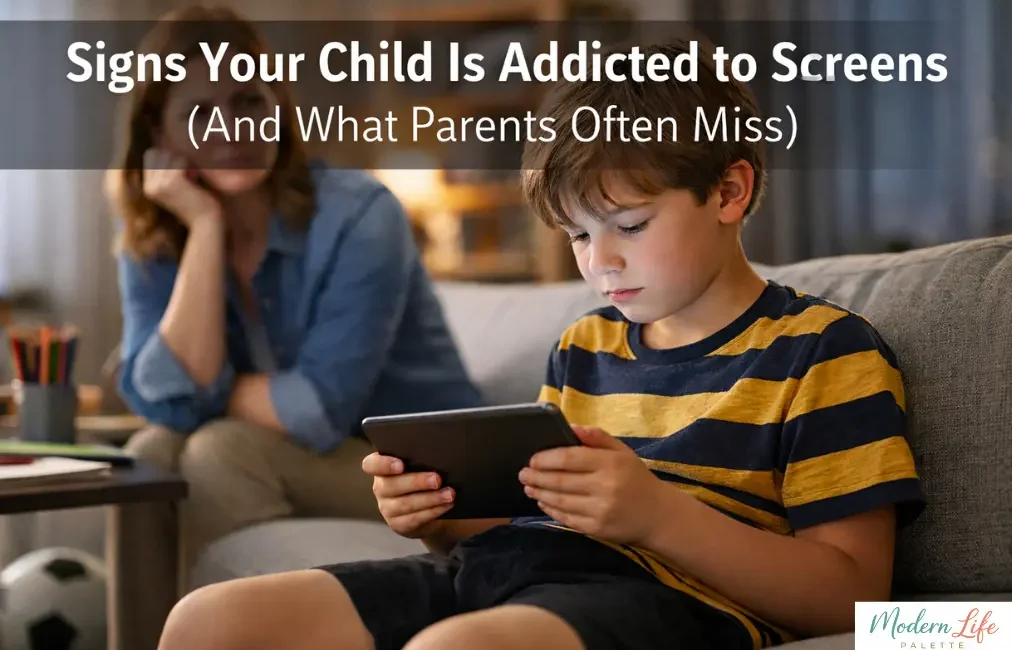
I didn’t notice it as a “problem” at first.
It was just small things about my child that started changing.
The way my child reacted when I asked to switch off the screen… the way everything else suddenly felt less interesting… the way screen time slowly became the most important part of the day.
Nothing extreme. Nothing alarming.
But enough to make me pause and wonder if these were early signs of screen addiction in kids-something that slowly builds without us noticing.”
If you’ve been noticing similar shifts, here are some real signs I personally started seeing in my child – not all at once, but gradually.
Signs of Screen Addiction in Kids
1. One of the First Signs: It’s Never Just “5 More Minutes”
Every time I say, “Okay, time to stop,” my child says the same thing -“Just 5 more minutes.”
I used to agree without thinking much about it. But over time, I realized those 5 minutes were never really 5.
More importantly, stopping the screen had become difficult – not optional.
2. A Clear Sign: Big Reactions When Screen Time Ends
One thing that really stood out was the reaction.
When I took the phone away, my child didn’t just feel disappointed – there was frustration, sometimes anger, sometimes tears.
And I kept wondering-why does something so small feel so big?
3. A Common Sign: Screens Are Always on My Child’s Mind
I started noticing how often my child would ask for the phone.
In the morning. After school. During free time.
Even when not using it, the next chance to get the screen was always somewhere in the background.
4. An Important Sign: Other Activities Don’t Feel Exciting Anymore
This was one of the hardest changes to accept.
Things my child used to genuinely enjoy like playing, drawing, even just sitting and talking – slowly started feeling like “time pass.”
The real excitement was reserved for the screen.
5. A Subtle Sign: Daily Routines Need Constant Reminding
Simple things started taking more effort. Getting homework done, getting ready, finishing small tasks – I found myself reminding my child again and again.
It wasn’t about ability. It felt like attention was constantly elsewhere.
6. A Sign Many Parents Miss: Sleep Patterns Changing
Bedtime started stretching. “Just one last video” became part of the routine. And even after the screen was off, my child didn’t fall asleep easily.
Mornings felt heavier too – less energy, more resistance.
7. A Social Sign: Choosing Screens Over People
There were moments that made me uncomfortable. When my child chose the screen over playing with friends… or seemed distracted during family time.
Not always – but enough to notice a shift.
8. A Strong Sign: Trying to Use Screens Secretly
The first time I noticed this, it stayed with me. My child using the phone quietly… or quickly hiding it when I walked in.
That’s when I realized this wasn’t just casual use anymore – it was a sign I needed to find how to reduce screen time for kids.
9. A Behavioral Sign: Conversations Keep Coming Back to Screens
Even when the device was off, it didn’t feel off. My child kept talking about games, videos, or what to watch next.
It felt like screens were always running in the background.
10. A Lifestyle Sign: Meals Depend on Screens
At some point, eating without a screen became difficult. “Put something on, then I’ll eat.”
And slowly, that became the default.
11. A Very Common Sign: “I’m Bored” Without Screens
Whenever there’s no screen, the response comes quickly – “I’m bored.”
Even when there are things to do, nothing seems engaging enough.
12. A Physical Sign: Small Health Complaints
I started noticing small things.
- My child rubbing his eyes more often.
- Sitting in one position for too long.
- Occasional complaints of headaches.
Individually, they didn’t seem serious—but together, they added up.
13. An Emotional Sign: Screens Become a Comfort Habit
On days when my child felt upset or low, the first instinct wasn’t to talk. It was to reach for a screen.
That’s when I realized it had become more than just entertainment.
14. A Pattern-Based Sign: Constantly Waiting for Screen Time
I could sense the anticipation. My child would keep asking when the next screen time was.
Checking. Waiting.
It felt like the day was built around that one thing.
15. A Final Sign: Rules Don’t Work the Same Way Anymore
Even after setting limits, I noticed my child trying to stretch them.
“Just today.”
“Only a little more.”
It didn’t feel like defiance – it felt like difficulty in stopping.
When These Signs Start Adding Up
Individually, any one of these signs may not mean much. But when I started noticing multiple signs showing up together, repeatedly – that’s when I knew I needed to pay attention.
Because it wasn’t just about screen time anymore. It was about how it was slowly affecting everything else.
What I Chose to Do Next?
Instead of making sudden, strict changes, I started with one simple step – setting daily screen time limits and sticking to them as much as possible.
A Simple Thought to End With
You don’t need to have all the answers right away. If these signs feel familiar, it doesn’t mean something is “wrong” – it just means it’s a good time to pause and reset a few habits.
Start small. Stay consistent. And most importantly, stay connected.
Because at the end of the day, what your child really needs isn’t just less screen time – it’s more of you.

Other Articles