
Has your baby’s doctor ever said, “Your baby is in the 25th percentile” and left you wondering what that actually means? You’re not alone. Many moms hear these numbers during a routine check-up and immediately start comparing their baby with others.
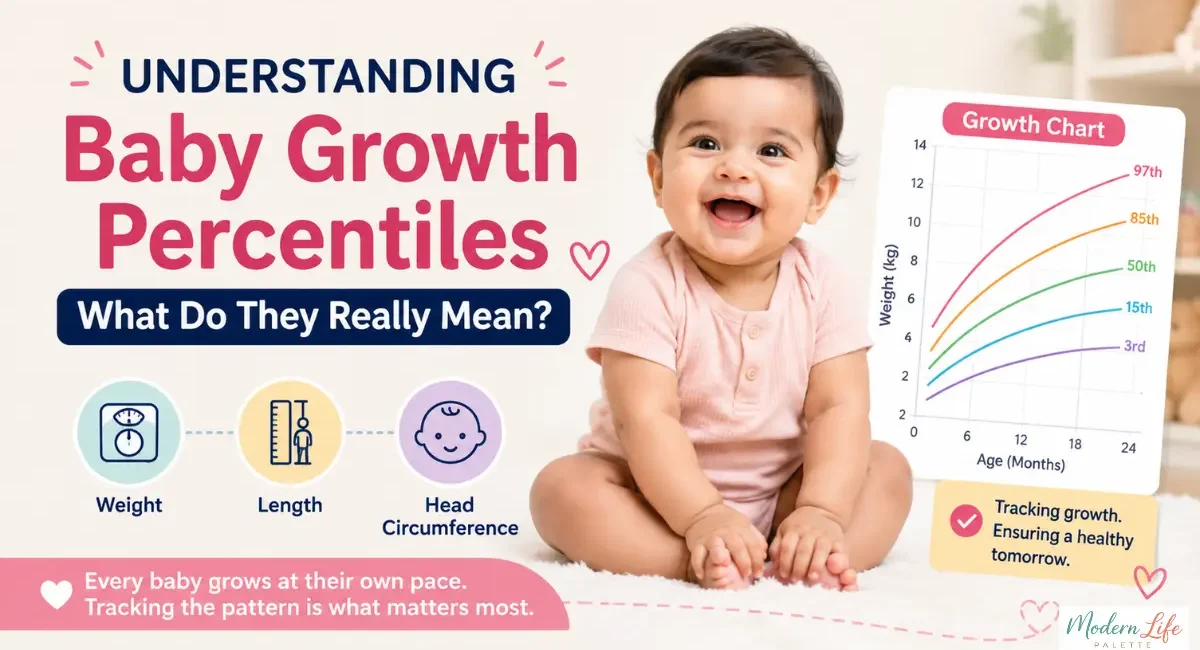
But here’s something important to know – a baby growth percentile shows how your baby’s weight, length, or head circumference compares with other babies of the same age and sex.
Being in the 25th, 50th, or 75th percentile does not automatically mean your baby is underweight, overweight, or healthier than other babies. What matters is how your baby’s growth develops over time and how the different measurements fit together.
In this article, we’ll break down baby growth percentiles in simple words so you know exactly what those numbers mean and when you should actually be concerned.
What Are Baby Growth Percentiles?
Baby growth percentiles are a way of comparing a baby’s growth measurements with those of other babies of the same age and sex. Doctors may use percentiles to track measurements such as weight, length or height, and head circumference over time.
For example, if your baby is at the 25th percentile for weight, it means that, within the reference population used for the growth chart, about 25% of babies have a lower measurement and about 75% have a higher measurement.
A percentile is not a grade or a score. Being at the 25th percentile does not automatically mean a baby is underweight, just as being at the 75th percentile does not mean a baby is healthier than one at the 25th percentile.
What matters most is the overall pattern of growth over time. Your baby’s pediatrician may look at several measurements together and consider factors such as age, sex, feeding, development, family characteristics, and overall health.
Why Are Baby Growth Percentiles Used?
Growth percentiles help healthcare professionals see how a baby’s measurements change over time and identify patterns that may need closer attention. A single percentile measurement usually provides less information than looking at how your baby’s growth progresses across multiple checkups.
It’s also normal for babies to have different percentiles for different measurements. For example, a baby could be around the 50th percentile for length but closer to the 25th percentile for weight. These numbers should be interpreted in context rather than treated as separate “good” or “bad” scores.
What Does Each Baby Growth Percentile Mean?
Once you see a percentile on your baby’s growth chart, it’s natural to wonder whether that number is too low, too high, or just right. The important thing to remember is that there is no single “best” baby growth percentile. A percentile simply shows where a measurement falls within the reference population used by the growth chart.
Here’s a simple way to understand common baby growth percentiles:
| Baby’s Percentile | What It Generally Means |
| 5th percentile | The measurement is higher than roughly 5% of babies in the reference population and lower than about 95%. |
| 10th percentile | The measurement is higher than roughly 10% of babies and lower than about 90%. |
| 15th percentile | The measurement is higher than roughly 15% of babies and lower than about 85%. |
| 25th percentile | The measurement is higher than roughly 25% of babies and lower than about 75%. |
| 50th percentile | The measurement is around the middle of the reference distribution. |
| 60th percentile | The measurement is higher than roughly 60% of babies and lower than about 40%. |
| 75th percentile | The measurement is higher than roughly 75% of babies and lower than about 25%. |
| 90th percentile | The measurement is higher than roughly 90% of babies and lower than about 10%. |
| 95th percentile | The measurement is higher than roughly 95% of babies and lower than about 5%. |
These numbers do not represent grades, health scores, or rankings. A baby at the 15th percentile is not automatically less healthy than a baby at the 75th percentile. Growth needs to be interpreted in context and followed over time.
What Does the 15th Percentile Mean for a Baby?
If your baby is at the 15th percentile, the measurement being assessed such as weight or length is higher than that of roughly 15% of babies in the reference population and lower than that of about 85%.
A 15th percentile measurement is not automatically a sign that something is wrong. Your pediatrician may consider your baby’s previous measurements, overall growth pattern, feeding, development, and other health factors before deciding whether there is anything to be concerned about.
What Does the 25th Percentile Mean for a Baby?
A baby at the 25th percentile has a measurement that is higher than roughly 25% of babies in the reference population and lower than about 75%.
For many parents, seeing a number below the 50th percentile can sound worrying. However, the 25th percentile is simply one point on the growth distribution. It does not by itself indicate that a baby is underweight or unhealthy.
What Does the 50th Percentile Mean for a Baby?
The 50th percentile is around the middle of the reference distribution. Roughly half of the babies in the reference population have a lower measurement and half have a higher measurement.
It is sometimes described as the “average” percentile, but that does not mean every healthy baby should be close to the 50th percentile. Healthy babies can naturally grow along many different percentile curves.
What Does the 60th Percentile Mean for a Baby?
If your baby is at the 60th percentile, the measurement is higher than that of roughly 60% of babies in the reference population and lower than about 40%.
Being above the 50th percentile does not mean a baby is healthier than one below the 50th percentile. The percentile simply describes the baby’s position within the reference distribution.
What Does the 75th Percentile Mean for a Baby?
A baby at the 75th percentile has a measurement that is higher than roughly 75% of babies in the reference population and lower than about 25%.
A 75th percentile measurement is not automatically “too high.” Whether a measurement is appropriate depends on which measurement is being assessed and how the baby’s growth has changed over time.
What Does the 90th Percentile Mean for a Baby?
At the 90th percentile, a baby’s measurement is higher than roughly 90% of babies in the reference population and lower than about 10%.
A higher percentile is not necessarily better. Just as a lower percentile is not automatically a problem, a higher percentile needs to be considered alo
Is a Higher Percentile Better?
No, a baby in the 15th percentile can be just as healthy as a baby in the 85th percentile. What matters is steady growth, not the number itself.
For example:
- A baby who has always been around the 20th percentile and continues to grow steadily is usually doing well.
- A baby who suddenly drops from the 75th percentile to the 25th percentile may need a closer look to understand the reason.
Doctors don’t expect every baby to reach the 50th percentile, instead, they look for a growth pattern that remains fairly consistent over time.
Baby Growth Percentiles by Measurement
A baby’s growth chart can show several different measurements, and each one tells you something different about growth. Your baby may be at a different percentile for weight, length, and head circumference and that’s not necessarily a problem.
Weight-for-Age
Weight-for-age compares your baby’s weight with other babies of the same age and sex.
For example, your baby might be at the 25th percentile for weight. This tells you where the baby’s weight falls within the reference population, but it doesn’t by itself tell you whether your baby is gaining weight appropriately.
That’s why weight is usually looked at alongside your baby’s previous measurements and other aspects of growth.
Length-for-Age
Length-for-age compares your baby’s length with other babies of the same age and sex.
A baby’s length can naturally fall at a different percentile from their weight. For babies under 2 years, length is generally measured while lying down rather than standing.
Weight-for-Length
Weight-for-length looks at your baby’s weight in relation to their length rather than age alone.
This can provide useful context because two babies of the same age may have very different lengths. Looking at weight in relation to length can help give a more complete picture of a baby’s growth.
Head Circumference-for-Age
Head circumference-for-age compares the measurement around your baby’s head with other babies of the same age and sex.
Head circumference is tracked because the head grows rapidly during infancy and early childhood. Your pediatrician can assess this measurement alongside your baby’s other growth measurements and overall development.
Why Your Baby’s Percentiles Don’t Have to Match?
Don’t worry if your baby’s percentiles aren’t the same across every measurement.
For example, your baby might be:
- 25th percentile for weight
- 50th percentile for length
- 75th percentile for head circumference
These numbers don’t need to match. Each measurement is being compared separately, and your pediatrician looks at the overall pattern rather than expecting every measurement to fall at the same percentile.
What Do Doctors Look for Besides the Percentile?
A growth percentile is only one piece of the puzzle, when your pediatrician checks your baby’s growth, they also look at several other things like:
- Whether your baby is gaining weight steadily
- Length (height) growth
- Head circumference growth
- Feeding habits
- Developmental milestones
- Overall health and activity level
For example, a baby in the 15th percentile who is feeding well, active, and meeting milestones may be perfectly healthy. On the other hand, a baby in the 70th percentile who has suddenly stopped gaining weight may need further evaluation.
This is why doctors focus on the overall growth pattern, not just one number. You can even refer to our Baby Weight Chart by Age (0–24 Months) to understand what’s considered the average weight at each stage.
Why Can a Baby’s Percentile Change?
It’s normal for a baby’s percentile to change a little, especially during the first two years. Several factors can influence growth such as:
- Growth spurts that happen during infancy.
- Feeding changes, such as starting solids or changes in milk intake.
- Minor illnesses that temporarily affect appetite.
- Genetics, as babies often inherit their parents’ body build.
- Premature birth, where doctors may use the baby’s corrected age to track growth.
A small change in percentile isn’t usually a reason to panic. Your pediatrician will look at the overall trend before deciding if anything needs attention.
When Should Parents Be Concerned?
A single percentile number is rarely a reason to worry. Doctors usually pay attention when they notice a sudden change in your baby’s growth pattern.
You should speak with your pediatrician if:
- Your baby is not gaining weight for several weeks.
- The percentile drops across two major percentile lines.
- Your baby has feeding difficulties.
- There is persistent vomiting or diarrhea.
- Your baby seems unusually sleepy or inactive.
- Developmental milestones are delayed.
For example, a baby moving from the 50th to the 40th percentile is often normal. But a drop from the 75th to the 10th percentile may need further evaluation.
Common Myths About Baby Growth Percentiles
It’s easy to worry when you hear different advice from family, friends, or social media. Here are a few common myths every parent should know.
| Myth | The Truth |
| A higher percentile means a healthier baby. | A higher percentile doesn’t mean a healthier baby. Babies can be healthy at any percentile if they’re growing steadily. |
| Every baby should be in the 50th percentile. | The 50th percentile is just the average. Healthy babies can naturally be above or below it. |
| A low percentile means the baby is underweight. | Not always. Some babies are naturally smaller and still grow normally. |
| Babies should keep moving to higher percentiles. | Babies don’t need to move up the chart. Consistent growth over time is what matters most. |
Conclusion
Baby growth percentiles are simply a tool to track your baby’s growth over time – they’re not a measure of how healthy your baby is. Every baby grows at their own pace, and a steady growth pattern is usually more important than the percentile itself. If you ever have concerns about your baby’s growth, it’s always best to discuss them with your pediatrician
Frequently Asked Questions
1. Is the 25th percentile normal for a baby?
Yes. A baby in the 25th percentile can be completely healthy if they are growing steadily and meeting milestones.
2. Can a baby’s percentile change over time?
Yes. Percentiles can change because of growth spurts, feeding changes, illness, or natural growth variations.
3. Which percentile is considered healthy?
There is no single “healthy percentile.” Babies across a wide range of percentiles can be healthy.
4. Should I worry if my baby’s percentile drops?
A small drop is often normal. A significant or persistent drop should be discussed with your pediatrician.
5. Are growth percentiles different for boys and girls?
Yes. Doctors use separate growth charts for boys and girls because their growth patterns are slightly different.
6. Do breastfed babies have different growth percentiles?
Breastfed babies may gain weight differently from formula-fed babies, especially after the first few months, and doctors interpret growth accordingly.
7. What does the 15th percentile mean for a baby?
The 15th percentile means your baby’s measurement is higher than about 15% of babies of the same age and sex and lower than about 85%. Being at the 15th percentile is not automatically a concern; your baby’s overall growth pattern matters more than one percentile.
8. Is the 15th percentile good or bad for a baby?
The 15th percentile can be completely normal for a baby. There is no single “good” or “bad” percentile because healthy babies can grow at different rates. Pediatricians look at your baby’s growth pattern over time rather than judging health from one percentile.
9. What does the 25th percentile mean for baby weight?
The 25th percentile for baby weight means your baby weighs more than about 25% of babies of the same age and sex and less than about 75%. A 25th-percentile weight does not automatically mean your baby is underweight or unhealthy.
10. What does the 50th percentile mean for babies?
The 50th percentile represents the median measurement for babies of the same age and sex. About half of babies measure above it and half below it. It does not mean that 50th percentile is the ideal or healthiest percentile for every baby.
11. What does the 75th percentile mean for a baby?
The 75th percentile means your baby’s measurement is higher than about 75% of babies of the same age and sex and lower than about 25%. A 75th percentile is not automatically too high. Your baby’s growth pattern and other measurements are also considered.
12. Is a higher percentile better for babies?
No. A higher percentile is not necessarily better for a baby. Growth percentiles are not grades or health scores. A baby at the 10th percentile can be healthy just as a baby at the 90th percentile can be, depending on their overall growth pattern.
13. What is the best percentile for babies?
There is no single best percentile for babies. The 50th percentile is the median, not a target that every baby should reach. Healthy babies can fall at different points on the growth chart, and doctors focus on consistent growth over time.
14. Do percentiles matter for babies?
Yes, percentiles help doctors track a baby’s growth over time, but one percentile does not tell the whole story. Weight, length, head circumference, and sometimes weight-for-length are considered together. A baby’s growth trend is generally more informative than a single percentile.
15. What is the average percentile for a baby?
The 50th percentile is the median and is often referred to as the middle or average point on a growth chart. However, 50th percentile is not the ideal percentile. Babies naturally vary in size, and healthy babies can be above or below the 50th percentile.
16. Is being in the 5th percentile good for a baby?
A baby at the 5th percentile can be healthy, particularly if they have consistently followed a similar growth pattern. However, a very low percentile or a significant change in growth should be discussed with your pediatrician. Percentile alone does not diagnose a growth problem.
17. What do different baby percentiles mean, such as the 26th, 27th, 28th, 29th, 31st, 37th, 43rd, 45th, 55th, 60th, 65th, 67th, 70th, and 76th percentile?
A baby percentile shows how a measurement compares with babies of the same age and sex. For example, the 26th percentile means the measurement is higher than about 26% of babies, while the 76th percentile means it is higher than about 76%. These numbers are not grades, and a higher percentile is not automatically better.
18. When do you find out a baby’s percentile?
A baby’s growth percentile can be calculated whenever their age, sex, and measurement are available. Pediatricians typically record measurements such as weight, length, and head circumference during routine checkups and plot them on an appropriate growth chart to monitor growth over time.